
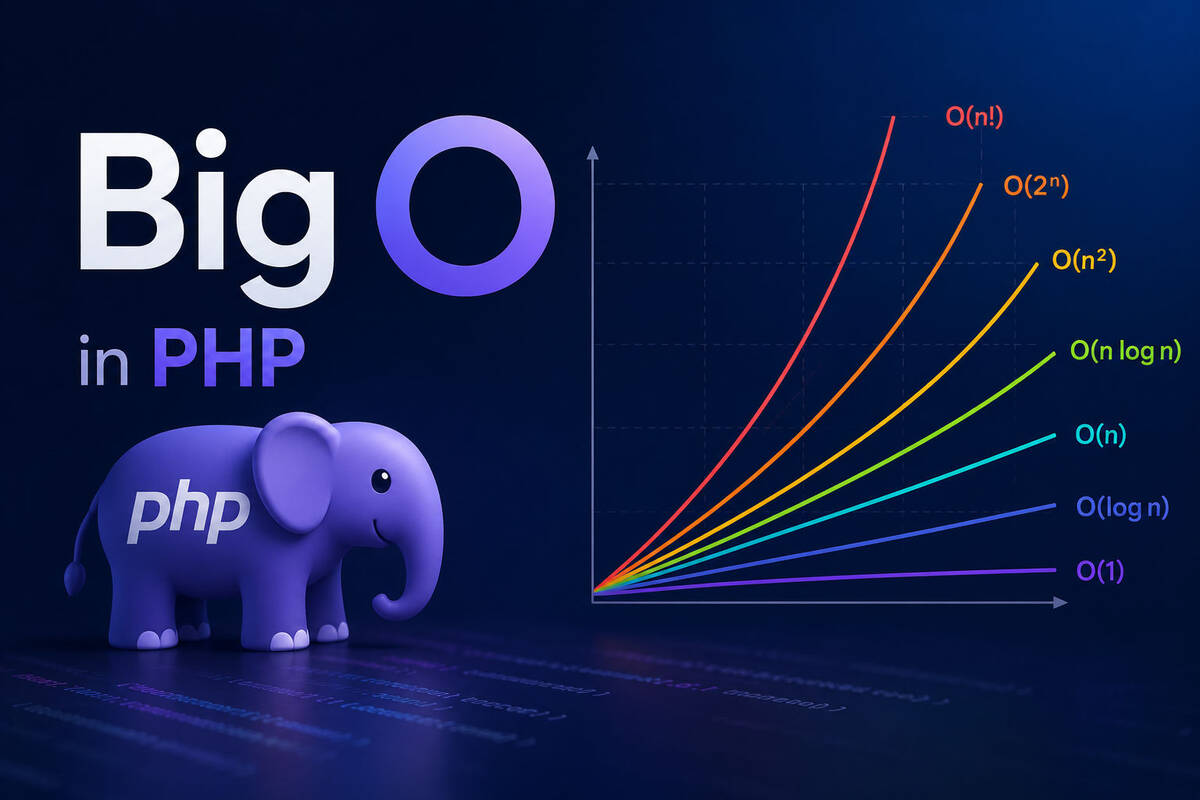
Big O in PHP: Complete Guide to Time Complexity (With Examples)
Learn Big O notation in PHP with practical examples, performance analysis, common mistakes, and optimization techniques every backend developer should know.
Table of Contents
Every PHP developer eventually reaches a point where code works—but no longer scales. An application that feels fast with a hundred records can become painfully slow with a hundred thousand. This is where Big O notation becomes one of the most valuable tools in a developer's toolbox.
Big O is not about measuring execution time in milliseconds. Instead, it helps us understand how an algorithm behaves as the amount of data grows. With this knowledge, we can predict bottlenecks, compare different implementations, and make better architectural decisions before performance problems appear.
In this guide, you'll learn Big O notation from a practical PHP perspective. We'll explore the most common complexity classes, analyze everyday PHP functions, optimize real-world code, and discuss the kinds of questions frequently asked in technical interviews. By the end, you'll be able to identify inefficient code, explain your optimization decisions, and write solutions that scale confidently.
What Is Big O?
When developers talk about an algorithm being fast or slow, they're usually referring to how well it scales as the amount of data increases—not how many milliseconds it takes to run on a specific computer.
This is exactly what Big O notation measures.
Big O describes how the time or memory usage of an algorithm grows as the input size increases. Instead of focusing on exact execution time, it focuses on the algorithm's growth rate, making it possible to compare different approaches regardless of hardware, programming language, or runtime environment.
For example, imagine you need to find a user in a list.
If the list contains only ten users, almost any approach will feel instantaneous. But what happens when the application has one million users? Suddenly, the algorithm you chose becomes much more important than the processor running it.
Suppose you search through the list one user at a time:
$users = [...];

foreach ($users as $user) {
    if ($user->id === $targetId) {
        return $user;
    }
}
In the worst case, PHP may need to inspect every element before finding the correct one—or determine that it doesn't exist. This operation has a time complexity of O(n), where n is the number of elements.
Now compare that with using an associative array indexed by user ID:
$users = [
    101 => $userA,
    102 => $userB,
    103 => $userC,
];

$user = $users[$targetId] ?? null;
Accessing an element by its key is, on average, a constant-time operation: O(1).
As the dataset grows, the difference becomes dramatic.
| Number of users | O(1) lookup | O(n) lookup |
|---|---|---|
| 100 | 1 operation | up to 100 operations |
| 1,000 | 1 operation | up to 1,000 operations |
| 1,000,000 | 1 operation | up to 1,000,000 operations |
This illustrates the main purpose of Big O: helping developers predict how an algorithm will behave before performance becomes a problem.
It's also important to understand what Big O doesn't measure.
Big O does not tell you:
- the exact execution time;
- how many CPU cycles an algorithm uses;
- how fast PHP is compared to another language;
- whether one implementation will always outperform another in practice.
Instead, it answers a much more valuable question:
How does this algorithm scale as the input size grows?
That is why Big O is one of the fundamental concepts in computer science and an essential skill for writing scalable applications.
Why Every PHP Developer Should Understand Big O
Many developers associate Big O with coding interviews or university courses, but its real value appears in everyday software development.
Whether you're building a Laravel application, a WordPress plugin, an API, or a CLI script, every line of code that processes collections of data has a computational cost.
Small inefficiencies often go unnoticed during development because local databases usually contain only a few records. However, those same algorithms can become significant bottlenecks once an application reaches production.
Consider this example:
$selectedIds = [...];

foreach ($users as $user) {
    if (in_array($user->id, $selectedIds)) {
        // Process user
    }
}
At first glance, this code looks perfectly reasonable.
The problem is that in_array() performs a linear search every time it is called. Since it runs inside another loop, the overall complexity becomes approximately O(n²).
A much more scalable solution is to convert the array into a lookup table:
$selected = array_flip($selectedIds);

foreach ($users as $user) {
    if (isset($selected[$user->id])) {
        // Process user
    }
}
Now the lookup is performed in constant time, reducing the overall complexity to approximately O(n).
The performance difference becomes enormous as the number of users increases.
Understanding Big O also helps you make better architectural decisions.
For example, you can answer questions like:
- Should I use an indexed associative array or a numeric array?
- Is caching worth the additional memory?
- Should I preprocess data before iterating over it?
- Is a nested loop unavoidable?
- Would a hash map eliminate repeated searches?
These decisions directly affect application scalability.
Big O is also highly relevant during code reviews. Experienced developers often recognize inefficient patterns immediately because they instinctively analyze the complexity of each operation rather than focusing only on whether the code works.
Finally, Big O plays a significant role in technical interviews.
Many companies ask candidates to:
- analyze the complexity of a piece of code;
- identify bottlenecks;
- optimize an algorithm;
- compare two possible implementations;
- explain the trade-offs between execution time and memory usage.
Being able to discuss these topics confidently demonstrates a deeper understanding of software engineering than simply knowing PHP syntax.
In short, Big O is not about writing clever algorithms—it is about writing software that continues to perform well as your application grows.
Time Complexity vs Space Complexity
When discussing Big O, most developers immediately think about execution speed. However, Big O can describe more than just how long an algorithm takes to finish.
There are two primary ways to analyze an algorithm:
- Time Complexity measures how the execution time grows as the input size increases.
- Space Complexity measures how much additional memory the algorithm requires.
These two metrics often compete with each other.
Sometimes you can make an algorithm significantly faster by consuming more memory. Other times, you can reduce memory usage at the cost of slower execution.
Time Complexity
Time complexity estimates how the number of operations grows as the input becomes larger.
For example:
$total = 0;

foreach ($numbers as $number) {
    $total += $number;
}
The loop visits every element exactly once.
If there are:
- 100 numbers
- 1,000 numbers
- 1,000,000 numbers
the work grows proportionally.
This is O(n).
Now consider nested loops:
foreach ($users as $user) {
    foreach ($orders as $order) {
        // Compare user and order
    }
}
If both collections contain n elements, the number of comparisons becomes roughly n × n, resulting in O(n²).
Space Complexity
Space complexity measures how much extra memory an algorithm allocates while running.
Consider this example:
$lookup = [];

foreach ($users as $user) {
    $lookup[$user->id] = $user;
}
The algorithm creates a second data structure containing every user.
If there are one million users, the lookup table also stores one million entries.
Its additional memory consumption grows linearly:
O(n) space complexity.
In contrast, this algorithm uses only a few variables regardless of input size:
$sum = 0;

foreach ($numbers as $number) {
    $sum += $number;
}
No additional collection is created.
The memory usage remains essentially constant:
O(1) space complexity.
The Trade-Off Between Time and Memory
One of the most common optimization techniques in software engineering is intentionally using more memory to reduce execution time.
For example:
| Approach | Time | Space |
|---|---|---|
Search using in_array() repeatedly |
O(n²) | O(1) |
| Build a lookup table first | O(n) | O(n) |
Neither solution is universally better.
If the dataset contains only a few dozen elements, the simpler implementation may be perfectly acceptable.
If the dataset contains millions of records and the operation runs thousands of times per second, investing additional memory to achieve a lower time complexity is almost always worthwhile.
Good software engineering is about balancing these trade-offs rather than blindly optimizing one metric.
Understanding Growth Rate
One of the biggest misconceptions about Big O is believing that it measures execution time.
It doesn't.
Big O measures how quickly an algorithm's cost increases as the input grows.
Imagine two algorithms.
Algorithm A processes 1,000 elements in 2 milliseconds.
Algorithm B processes the same data in 10 milliseconds.
At first glance, Algorithm A appears to be faster.
Now imagine processing one billion elements.
If Algorithm A has a complexity of O(n²) and Algorithm B has a complexity of O(n log n), the second algorithm will eventually become dramatically faster despite having been slower for small datasets.
This is why software engineers care more about growth rate than benchmark results.
The following table illustrates how common complexity classes scale:
| Input Size (n) | O(1) | O(log n) | O(n) | O(n log n) | O(n²) |
|---|---|---|---|---|---|
| 10 | 1 | ~3 | 10 | ~33 | 100 |
| 100 | 1 | ~7 | 100 | ~664 | 10,000 |
| 1,000 | 1 | ~10 | 1,000 | ~9,966 | 1,000,000 |
| 1,000,000 | 1 | ~20 | 1,000,000 | ~19,931,569 | 1,000,000,000,000 |
Notice how some algorithms grow very slowly, while others become impractical surprisingly quickly.
Another important concept is that Big O ignores constants.
These two algorithms have the same complexity:
foreach ($items as $item) {
    // ...
}
foreach ($items as $item) {
    // Operation 1
    // Operation 2
    // Operation 3
    // Operation 4
    // Operation 5
}
The second loop performs roughly five times more work, but both still execute once per element.
Their complexity is:
O(n)
Similarly, Big O ignores lower-order terms.
Consider this example:
foreach ($users as $user) {
    // O(n)
}

foreach ($orders as $order) {
    // O(n)
}
The total complexity is:
O(n + n)
Which simplifies to:
O(2n)
And finally to:
O(n)
Likewise:
O(n² + n)
becomes:
O(n²)
because, as n grows, the quadratic term dominates the linear one.
Understanding growth rate allows you to reason about scalability without relying on benchmarks or hardware. Instead of asking "How fast is this code on my laptop?", you begin asking the more important question:
"How will this algorithm behave when my application processes ten, one thousand, or ten million times more data?"
That shift in perspective is what makes Big O such a powerful tool for designing scalable software.
The Most Common Big O Complexities
Not all algorithms scale the same way. Some remain fast even when processing millions of records, while others become impractical with only a few thousand.
Understanding the most common Big O complexities helps you quickly evaluate whether an implementation is likely to scale.
The following sections introduce the complexity classes every PHP developer should know.
O(1) — Constant Time
An O(1) algorithm performs the same amount of work regardless of the input size.
Whether the array contains ten elements or ten million, the number of operations stays essentially the same.
A common example is accessing an element by its index:
$numbers = [10, 20, 30, 40];

$value = $numbers[2];
Or accessing an associative array by its key:
$users = [
    101 => 'Alice',
    102 => 'Bob',
];

$name = $users[101];
These operations are considered constant time because PHP can directly calculate where the value is stored.
Typical examples include:
- Accessing an array index
- Accessing an associative array key
isset($array[$key])count()(for arrays)strlen()(for strings)
Constant-time algorithms are generally the most scalable.
O(log n) — Logarithmic Time
Logarithmic algorithms become only slightly slower as the input grows.
Instead of checking every element, they repeatedly eliminate half of the remaining possibilities.
The classic example is Binary Search.
Imagine searching for a word in a dictionary.
You don't start from page one—you open near the middle, decide whether the word comes before or after that page, discard half the book, and repeat.
Each step cuts the remaining search space in half.
For one million elements, binary search requires only about 20 comparisons.
Although PHP doesn't include a built-in binary search function, implementing one on a sorted array is straightforward.
However, binary search only works on sorted data.
Imagine you're looking for the number 42 in a sorted array of one million integers. Instead of potentially inspecting every value, binary search checks the middle element first:
- If the middle value is too small, it discards the lower half.
- If it's too large, it discards the upper half.
- It repeats the process until the value is found or no elements remain.
Each iteration cuts the remaining search space in half, resulting in a logarithmic time complexity.
<?php

function binarySearch(array $numbers, int $target): ?int
{
    $left = 0;
    $right = count($numbers) - 1;

    while ($left <= $right) {
        $middle = intdiv($left + $right, 2);

        if ($numbers[$middle] === $target) {
            return $middle;
        }

        if ($numbers[$middle] < $target) {
            $left = $middle + 1;
        } else {
            $right = $middle - 1;
        }
    }

    return null;
}

$numbers = [3, 7, 12, 18, 24, 31, 42, 56, 67, 81];

$index = binarySearch($numbers, 42);

echo $index; // 6
O(n) — Linear Time
An O(n) algorithm processes each element once.
If the input doubles, the work roughly doubles as well.
For example:
$total = 0;

foreach ($numbers as $number) {
    $total += $number;
}
Or searching for a value:
foreach ($users as $user) {
    if ($user->id === $id) {
        return $user;
    }
}
Many PHP functions are linear:
in_array()array_search()array_filter()array_map()array_reduce()
Linear algorithms are perfectly acceptable for most applications and are often unavoidable.
O(n log n) — Linearithmic Time
This complexity appears in many efficient sorting algorithms.
The algorithm still processes every element, but it also performs additional logarithmic work.
Most comparison-based sorting algorithms fall into this category, including:
- Merge Sort
- Heap Sort
- Quick Sort (average case)
PHP's built-in sorting functions such as:
sort($numbers);
and
usort($users, $comparator);
typically execute in O(n log n) time.
Although slower than linear algorithms, this complexity scales very well and is considered optimal for general-purpose comparison sorting.
O(n²) — Quadratic Time
Quadratic algorithms perform work proportional to the square of the input size.
They usually appear when one loop is nested inside another.
Example:
foreach ($users as $user) {
    foreach ($orders as $order) {
        // Compare user and order
    }
}
If each array contains 10,000 elements, the number of comparisons may reach 100 million.
Another common example is repeatedly calling in_array() inside a loop:
foreach ($users as $user) {
    if (in_array($user->id, $selectedIds)) {
        // ...
    }
}
This pattern is surprisingly common in production code and often becomes a performance bottleneck.
Whenever possible, replacing repeated linear searches with hash lookups can reduce the complexity to O(n).
O(2ⁿ) — Exponential Time
Exponential algorithms double their work whenever the input increases by one.
This growth becomes unmanageable extremely quickly.
For example:
| Input | Operations |
|---|---|
| 10 | 1,024 |
| 20 | 1,048,576 |
| 30 | 1,073,741,824 |
Recursive brute-force solutions often have exponential complexity.
Example:
function fibonacci(int $n): int
{
    if ($n <= 1) {
        return $n;
    }

    return fibonacci($n - 1) + fibonacci($n - 2);
}
This implementation recalculates the same values repeatedly, causing exponential growth.
Using memoization or dynamic programming reduces the complexity dramatically.
O(n!) — Factorial Time
Factorial complexity is even worse than exponential growth.
These algorithms generate every possible ordering or combination of a dataset.
For example, finding every possible arrangement of ten objects requires:
10! = 3,628,800
For fifteen objects:
15! ≈ 1.3 trillion
Problems involving permutations, exhaustive search, or the Traveling Salesman Problem often have factorial complexity.
Fortunately, most web applications never need algorithms this expensive.
Complexity Comparison
| Complexity | Growth | Typical Example |
|---|---|---|
| O(1) | Excellent | Array access |
| O(log n) | Excellent | Binary search |
| O(n) | Good | Single loop |
| O(n log n) | Very Good | Sorting |
| O(n²) | Poor | Nested loops |
| O(2ⁿ) | Very Poor | Recursive brute force |
| O(n!) | Impractical | Permutations |
As a rule of thumb:
- O(1) and O(log n) are ideal.
- O(n) is usually acceptable.
- O(n log n) is expected for sorting.
- O(n²) deserves careful review.
- O(2ⁿ) and O(n!) should generally be avoided unless the problem itself requires them.
Big O Visual Comparison
One of the easiest ways to understand Big O is to visualize how different algorithms grow as the input size increases.
The following table shows the approximate number of operations required for common complexity classes.
| Input Size (n) | O(1) | O(log n) | O(n) | O(n log n) | O(n²) | O(2ⁿ) |
|---|---|---|---|---|---|---|
| 10 | 1 | 3 | 10 | 33 | 100 | 1,024 |
| 100 | 1 | 7 | 100 | 664 | 10,000 | Impossible |
| 1,000 | 1 | 10 | 1,000 | 9,966 | 1,000,000 | Impossible |
| 1,000,000 | 1 | 20 | 1,000,000 | ~20 million | 1 trillion | Impossible |
Notice how slowly logarithmic algorithms grow compared to quadratic or exponential ones.
Another useful way to think about complexity is by imagining what happens when the input doubles.
| Complexity | What happens when n doubles? |
|---|---|
| O(1) | No noticeable change |
| O(log n) | Slight increase |
| O(n) | Roughly twice the work |
| O(n log n) | Slightly more than twice |
| O(n²) | Roughly four times the work |
| O(2ⁿ) | Approximately doubles again |
| O(n!) | Explodes dramatically |
This is why experienced developers focus less on benchmark numbers and more on algorithmic complexity. An implementation that is slightly slower today may outperform another by several orders of magnitude as the application grows.
Big O with PHP Arrays
PHP arrays are one of the language's most powerful features. However, many developers assume that every array operation has the same cost—which is far from true.
Knowing the complexity of common array operations helps you write more efficient code and avoid accidental bottlenecks.
Note: PHP arrays are ordered hash tables. They combine characteristics of traditional arrays and hash maps, so some operations are constant-time while others require scanning or copying the array.
Access
Accessing an element by its index or key is generally a constant-time operation.
$numbers = [10, 20, 30];

echo $numbers[1];
Complexity:
O(1)
The same applies to associative arrays.
Search
Searching by value requires scanning the array until the element is found.
if (in_array(30, $numbers)) {
    // ...
}
Or:
$key = array_search(30, $numbers);
Complexity:
O(n)
In the worst case, PHP checks every element.
Insert
Appending an element to the end of an array is typically constant time.
$numbers[] = 50;
Average complexity:
O(1)
However, inserting at the beginning requires shifting every existing element.
array_unshift($numbers, 5);
Complexity:
O(n)
Likewise, inserting into the middle generally requires moving subsequent elements.
Remove
Removing the last element is inexpensive.
array_pop($numbers);
Complexity:
O(1)
Removing the first element is more expensive because every remaining element must be reindexed.
array_shift($numbers);
Complexity:
O(n)
Removing an arbitrary element also tends to require shifting elements.
Summary
| Operation | Complexity |
|---|---|
| Access by index | O(1) |
| Append | O(1) amortized |
| Pop | O(1) |
| Search | O(n) |
| Insert at beginning | O(n) |
| Remove from beginning | O(n) |
| Insert in middle | O(n) |
| Remove in middle | O(n) |
Understanding these costs helps explain why operations near the beginning of large arrays are often much slower than operations performed at the end.
Big O with Associative Arrays (Hash Maps)
One of PHP's greatest strengths is its implementation of associative arrays.
Internally, PHP uses a hash table, allowing keys to be mapped directly to values.
Instead of searching sequentially through the array, PHP computes a hash of the key and jumps directly to the corresponding bucket.
This makes associative arrays incredibly efficient for lookups.
$users = [
    101 => 'Alice',
    102 => 'Bob',
    103 => 'Charlie',
];

echo $users[102];
Average complexity:
O(1)
Checking whether a key exists is also constant time.
if (isset($users[$id])) {
    // ...
}
Complexity:
O(1)
This is one of the reasons isset() is often much faster than in_array().
Consider the following code:
foreach ($users as $user) {
    if (in_array($user->id, $selectedIds)) {
        // ...
    }
}
Each iteration performs a linear search, producing approximately:
O(n²)
A better approach is to build a lookup table first.
$selected = array_flip($selectedIds);

foreach ($users as $user) {
    if (isset($selected[$user->id])) {
        // ...
    }
}
Now the lookup becomes constant time, reducing the overall complexity to approximately:
O(n)
This optimization is frequently used in production systems that process large collections of IDs, permissions, products, users, or database records.
Common Hash Map Operations
| Operation | Complexity |
|---|---|
| Read by key | O(1) average |
| Insert by key | O(1) average |
| Update by key | O(1) average |
isset($array[$key]) |
O(1) average |
unset($array[$key]) |
O(1) average |
| Iterate over all elements | O(n) |
Although hash collisions can theoretically degrade performance to O(n), PHP's hashing implementation is designed to keep lookups close to constant time in normal applications.
For this reason, whenever you find yourself repeatedly searching for values inside large arrays, it's worth asking a simple question:
Can this collection be transformed into a hash map?
More often than not, the answer leads to one of the biggest performance improvements you can make with only a few lines of code.
Loops and Nested Loops
Loops are one of the easiest ways to estimate an algorithm's complexity.
As a general rule:
- A single loop is usually O(n).
- Two consecutive loops are still O(n).
- Nested loops often result in O(n²).
- The complexity depends on how many times each loop executes.
Let's look at the most common scenarios.
Single Loop — O(n)
A loop that processes each element exactly once has linear complexity.
$total = 0;

foreach ($numbers as $number) {
    $total += $number;
}
Complexity:
O(n)
The number of operations grows proportionally to the number of elements.
Consecutive Loops — Still O(n)
Developers sometimes assume that two loops automatically mean O(n²).
That's incorrect.
foreach ($users as $user) {
    // Process users
}

foreach ($orders as $order) {
    // Process orders
}
The complexity is:
O(n + n)
Which simplifies to:
O(n)
Since Big O ignores constant factors.
Nested Loops — O(n²)
When one loop executes completely for every iteration of another, the complexity becomes quadratic.
foreach ($users as $user) {
    foreach ($orders as $order) {
        if ($user->id === $order->userId) {
            // ...
        }
    }
}
Complexity:
O(n²)
With 100 users and 100 orders, there may be up to 10,000 comparisons.
With 10,000 users and 10,000 orders, that becomes 100 million comparisons.
Nested Loops Are Not Always O(n²)
The complexity depends on how many times the inner loop executes.
Consider this example:
for ($i = 0; $i < $n; $i++) {
    for ($j = $i; $j < $n; $j++) {
        // ...
    }
}
Although the second loop executes fewer times on each iteration, the overall complexity is still quadratic.
However, this example is different:
$i = 0;

while ($i < $n) {
    $i *= 2;
}
Each iteration doubles the value of $i.
Complexity:
O(log n)
The important lesson is that loops alone do not determine complexity. What matters is how many times they execute.
Breaking Early
Sometimes a loop finishes before processing every element.
foreach ($users as $user) {
    if ($user->id === $targetId) {
        break;
    }
}
Best case:
O(1)
Worst case:
O(n)
Big O generally describes the worst-case scenario, unless explicitly stated otherwise.
Summary
| Pattern | Complexity |
|---|---|
| Single loop | O(n) |
| Two consecutive loops | O(n) |
| Nested loops | O(n²) |
| Loop dividing work in half | O(log n) |
| Loop with constant operations | O(1) |
Whenever you see nested loops, it's worth asking:
Can one of these loops be replaced with a hash map lookup?
Very often, the answer reduces an algorithm from O(n²) to O(n).
Common PHP Functions and Their Complexity
Understanding the complexity of PHP's built-in functions can help you identify performance issues before they become bottlenecks.
The following table summarizes the average time complexity of some of the most commonly used functions.
| Function | Average Complexity | Notes |
|---|---|---|
isset($array[$key]) |
O(1) | Hash lookup |
array_key_exists() |
O(1) | Hash lookup |
count() |
O(1) | Arrays only |
strlen() |
O(1) | Strings store their length |
in_array() |
O(n) | Linear search |
array_search() |
O(n) | Linear search |
array_map() |
O(n) | Visits every element |
array_filter() |
O(n) | Visits every element |
array_reduce() |
O(n) | Visits every element |
array_flip() |
O(n) | Processes every element |
array_unique() |
O(n) average | Uses hashing internally |
array_merge() |
O(n) | Copies arrays |
sort() |
O(n log n) | Sorting |
rsort() |
O(n log n) | Sorting |
asort() |
O(n log n) | Sorting |
ksort() |
O(n log n) | Sorting |
usort() |
O(n log n) | User-defined comparison |
Let's examine the most important ones.
in_array()
if (in_array($id, $ids)) {
    // ...
}
Complexity:
O(n)
PHP checks elements one by one until it finds a match.
array_search()
$key = array_search($id, $ids);
Complexity:
O(n)
The entire array may need to be scanned.
isset()
isset($users[$id]);
Complexity:
O(1)
One of the fastest lookup operations in PHP.
array_key_exists()
array_key_exists($id, $users);
Complexity:
O(1)
Unlike isset(), this function also returns true for keys whose value is null.
$users = [
    1 => null,
];

isset($users[1]);             // false
array_key_exists(1, $users);  // true
sort() and usort()
Sorting algorithms generally run in:
O(n log n)
Regardless of which comparison function you provide.
array_merge()
$result = array_merge($a, $b);
Complexity:
O(n)
The resulting array is rebuilt, requiring every element to be copied.
array_unique()
$result = array_unique($values);
Average complexity:
O(n)
PHP uses hashing internally to detect duplicate values efficiently.
array_flip()
$lookup = array_flip($ids);
Complexity:
O(n)
Although creating the lookup table requires one linear pass, subsequent lookups become constant time.
array_map() and array_filter()
$result = array_map(
    fn ($user) => $user->name,
    $users
);
$active = array_filter(
    $users,
    fn ($user) => $user->active
);
Both functions process every element once.
Complexity:
O(n)
Practical Examples
Theory is useful, but Big O becomes much easier to understand when applied to real-world PHP code.
The following examples demonstrate common performance pitfalls and how to improve them.
Finding Duplicates
A common beginner approach compares every element against every other element.
$duplicates = [];

foreach ($numbers as $i => $a) {
    foreach ($numbers as $j => $b) {
        if ($i !== $j && $a === $b) {
            $duplicates[] = $a;
        }
    }
}
Complexity:
O(n²)
A much better solution uses a hash map.
$seen = [];
$duplicates = [];

foreach ($numbers as $number) {
    if (isset($seen[$number])) {
        $duplicates[] = $number;
    } else {
        $seen[$number] = true;
    }
}
Complexity:
O(n)
Removing Duplicates
PHP already provides an optimized solution.
$result = array_unique($numbers);
Average complexity:
O(n)
Trying to remove duplicates manually with nested loops would usually result in O(n²).
Counting Frequencies
Suppose you need to count how many times each word appears.
$counts = [];

foreach ($words as $word) {
    $counts[$word] = ($counts[$word] ?? 0) + 1;
}
Complexity:
O(n)
This pattern appears frequently when generating reports, analytics, or statistics.
Searching Users
Inefficient approach:
foreach ($users as $user) {
    if ($user->id === $targetId) {
        return $user;
    }
}
Complexity:
O(n)
Optimized approach:
$userMap = [];

foreach ($users as $user) {
    $userMap[$user->id] = $user;
}

return $userMap[$targetId] ?? null;
Building the lookup table:
O(n)
Each subsequent lookup:
O(1)
This optimization becomes extremely valuable when multiple lookups are required.
Pagination
Many developers retrieve an entire dataset before slicing it.
$page = array_slice($users, $offset, $limit);
While array_slice() itself is efficient, the real problem often occurs earlier:
$users = $repository->findAll();
Loading one million records into memory just to display twenty is far more expensive than letting the database perform pagination.
A better approach is:
SELECT *
FROM users
LIMIT 20 OFFSET 100;
Whenever possible, filter and paginate data as close to the data source as possible instead of processing unnecessary records in PHP.
How to Optimize PHP Code Using Big O
Big O is more than a theoretical concept—it provides practical guidelines for writing faster, more scalable PHP applications.
The goal is not to optimize every line of code prematurely, but to recognize patterns that become expensive as datasets grow.
Here are some of the most effective optimization strategies.
Prefer Hash Lookups Over Linear Searches
Instead of repeatedly scanning an array:
in_array($id, $ids);
Create a lookup table once.
$lookup = array_flip($ids);

isset($lookup[$id]);
This is one of the most impactful optimizations in PHP.
Avoid Nested Loops Whenever Possible
Nested loops are often a sign that a hash map or preprocessing step could reduce complexity.
Instead of:
foreach ($users as $user) {
    foreach ($permissions as $permission) {
        // ...
    }
}
Build an indexed structure first.
Choose the Right Data Structure
Not every collection should be a numeric array.
Use:
- associative arrays for lookups;
- lists for sequential data;
- specialized SPL structures when appropriate.
The right data structure often matters more than micro-optimizing code.
Sort Only When Necessary
Sorting is relatively expensive.
Avoid code like:
sort($items);
inside loops or repeated requests unless the ordering is actually required.
Whenever possible, let the database sort the data before PHP receives it.
Reduce Repeated Work
If an expensive calculation is performed multiple times, compute it once.
Instead of:
foreach ($users as $user) {
    $permissions = getPermissions($user);
}
Consider caching or preloading the data when appropriate.
Repeated work is one of the most common sources of hidden inefficiency.
Let the Database Do the Heavy Lifting
Databases are optimized for searching, sorting, filtering, grouping, and aggregating large datasets.
Instead of retrieving every record and filtering in PHP:
$users = $repository->findAll();

$active = array_filter(
    $users,
    fn ($user) => $user->active
);
Use SQL:
SELECT *
FROM users
WHERE active = 1;
Moving work closer to the database often reduces both execution time and memory usage.
Measure Before Optimizing
Big O predicts scalability, but profiling reveals real bottlenecks.
Before rewriting code, ask yourself:
- Is this code actually slow?
- Is the dataset large enough to matter?
- Is this function executed frequently?
- Would a simpler solution be easier to maintain?
Premature optimization can make code more complex without delivering meaningful benefits.
Think About Scale
Perhaps the most valuable habit is asking one simple question whenever you write an algorithm:
What happens if this collection grows from one hundred elements to one million?
That mindset naturally leads to better architectural decisions, more efficient code, and applications that continue to perform well as they grow. It is precisely this ability to reason about scalability—not merely to write working code—that distinguishes experienced software engineers from developers who focus solely on implementation.
Common Mistakes
Understanding Big O is one thing; applying it correctly is another. Many performance issues in production applications stem from a few recurring misconceptions rather than genuinely complex algorithms.
Here are some of the most common mistakes PHP developers make.
Mistake #1: Optimizing Too Early
One of the best-known principles in software engineering is:
Premature optimization is the root of all evil.
— Donald Knuth
Developers sometimes spend hours replacing perfectly readable code with more complex implementations to save a few milliseconds on operations that execute only a handful of times.
For example:
foreach ($users as $user) {
    // ...
}
There is nothing inherently wrong with an O(n) algorithm. If the collection contains only a few hundred elements and runs once per request, the simpler solution is usually the better one.
Always optimize where performance actually matters.
Mistake #2: Ignoring Algorithmic Complexity
The opposite mistake is assuming that modern hardware will solve every performance problem.
Code like this often works perfectly during development:
foreach ($users as $user) {
    if (in_array($user->id, $selectedIds)) {
        // ...
    }
}
Until one day:
$userscontains 500,000 records;$selectedIdscontains 100,000 IDs;- the request suddenly takes several seconds.
Understanding Big O helps you identify these bottlenecks before they reach production.
Mistake #3: Assuming Nested Loops Are Always Bad
Nested loops are often associated with O(n²) complexity, but they are not automatically inefficient.
For example:
foreach ($users as $user) {
    foreach ($user->roles as $role) {
        // ...
    }
}
If each user has only two or three roles, the inner loop is effectively constant.
The actual complexity is closer to:
O(n)
What matters is not the number of loops, but how many total iterations occur.
Mistake #4: Ignoring Space Complexity
Developers often focus exclusively on execution time.
Sometimes reducing an algorithm from O(n²) to O(n) requires allocating an additional lookup table.
$lookup = array_flip($ids);
This consumes more memory but dramatically reduces lookup time.
Optimization is almost always a trade-off between CPU time, memory usage, readability, and maintainability.
Mistake #5: Using the Wrong Data Structure
Many developers solve every problem with numeric arrays.
However, if your primary operation is lookup by ID, an associative array is usually the better choice.
Instead of:
[
    ['id' => 101, 'name' => 'Alice'],
    ['id' => 102, 'name' => 'Bob'],
]
Consider:
[
    101 => $alice,
    102 => $bob,
]
The difference between O(n) and O(1) lookups can be enormous.
Mistake #6: Confusing Big O with Execution Time
Big O does not answer questions like:
- "Will this code run in 15 ms?"
- "Is PHP faster than Go?"
- "Is Laravel slower than Symfony?"
It only describes how an algorithm scales as the input grows.
A slower algorithm may outperform another for small datasets, while becoming dramatically worse for larger ones.
Mistake #7: Ignoring Built-in Functions
PHP's standard library has been optimized for decades.
Many developers write custom implementations of sorting, duplicate removal, or filtering when PHP already provides efficient native functions.
Before reinventing the wheel, check whether the language already offers a well-tested solution.
Big O in Technical Interviews
If you've ever interviewed for a backend or software engineering position, you've probably encountered Big O.
Interviewers are usually less interested in whether you remember every complexity by heart and more interested in how you think.
They want to know whether you can:
- identify inefficient algorithms;
- estimate complexity;
- explain trade-offs;
- improve an existing solution.
Here are some of the most common interview questions.
"What's the complexity of this code?"
You may receive something like:
foreach ($users as $user) {
    foreach ($orders as $order) {
        if ($user->id === $order->userId) {
            // ...
        }
    }
}
A good answer would explain that the nested loops produce approximately:
O(n²)
and suggest replacing one of the collections with a hash map.
"Can you optimize it?"
Interviewers often expect something similar to this transformation:
Before:
foreach ($users as $user) {
    if (in_array($user->id, $selectedIds)) {
        // ...
    }
}
After:
$selected = array_flip($selectedIds);

foreach ($users as $user) {
    if (isset($selected[$user->id])) {
        // ...
    }
}
Being able to explain why the second version scales better is often more important than writing it.
"What are the trade-offs?"
A strong answer acknowledges both sides.
For example:
- faster lookups;
- higher memory consumption;
- slightly more complex code.
Interviewers appreciate candidates who recognize that optimization is rarely free.
"Can you estimate the complexity without running the code?"
This is a valuable skill.
You should be able to estimate complexity simply by reading the implementation.
Questions like these become much easier once you learn to recognize common patterns:
- single loop → O(n)
- binary search → O(log n)
- sorting → O(n log n)
- nested loops → usually O(n²)
- recursion → depends on the recursive structure
What Interviewers Really Want
Many candidates memorize complexity tables.
Stronger candidates explain why an algorithm has a particular complexity, discuss possible optimizations, and evaluate whether those optimizations are worthwhile.
That ability demonstrates practical engineering judgment rather than rote memorization.
Frequently Asked Questions
Is O(n) always bad?
No.
Most real-world applications contain many O(n) algorithms.
Linear complexity is often the best possible solution, especially when every element must be processed.
Is O(1) always possible?
No.
Some problems fundamentally require examining every element.
For example, calculating the sum of an array cannot be done without visiting each value.
Is O(log n) faster than O(n)?
Almost always for sufficiently large datasets.
For one million elements:
- O(log n) performs roughly 20 steps.
- O(n) performs one million.
That difference becomes enormous as data grows.
Why is isset() usually faster than in_array()?
isset() performs a hash table lookup using a key.
in_array() searches values sequentially until it finds a match.
Average complexity:
| Function | Complexity |
|---|---|
isset() |
O(1) |
in_array() |
O(n) |
Should I always optimize for Big O?
No.
Readability, maintainability, and simplicity are also important.
A theoretically optimal algorithm that is difficult to understand may not be the best engineering choice for a small dataset.
Does Big O apply only to algorithms?
No.
It applies to virtually every operation involving data:
- searching;
- sorting;
- filtering;
- database indexing;
- caching;
- networking;
- filesystem operations;
- data structures.
Does Big O guarantee real-world performance?
Not by itself.
Actual performance also depends on:
- hardware;
- memory hierarchy;
- compiler or interpreter optimizations;
- PHP version;
- extensions;
- operating system;
- cache efficiency.
Big O predicts scalability—not benchmark numbers.
Conclusion
Big O notation is much more than an academic concept or a topic reserved for coding interviews. It provides a practical framework for understanding how software behaves as applications grow and datasets become larger.
Throughout this guide, we've explored how different complexity classes scale, why growth rate matters more than raw execution time, and how everyday PHP code can be optimized simply by choosing better algorithms or more appropriate data structures.
The most important lesson is that performance is rarely about writing clever code. More often, it comes down to recognizing inefficient patterns—such as repeated linear searches or unnecessary nested loops—and replacing them with scalable alternatives like hash table lookups.
As a PHP developer, you don't need to memorize every complexity formula. Instead, develop the habit of asking a few simple questions whenever you write or review code:
- How many times does this loop execute?
- Am I repeatedly searching the same data?
- Would a different data structure improve performance?
- What happens if this dataset grows from hundreds of records to millions?
These questions naturally lead to better architectural decisions, more maintainable code, and applications that continue to perform well under increasing load.
Ultimately, mastering Big O is not about impressing interviewers—although it certainly helps during technical interviews. It's about building software that scales gracefully, solving problems efficiently, and becoming the kind of engineer who understands not just how code works, but why one solution is fundamentally better than another.